Books
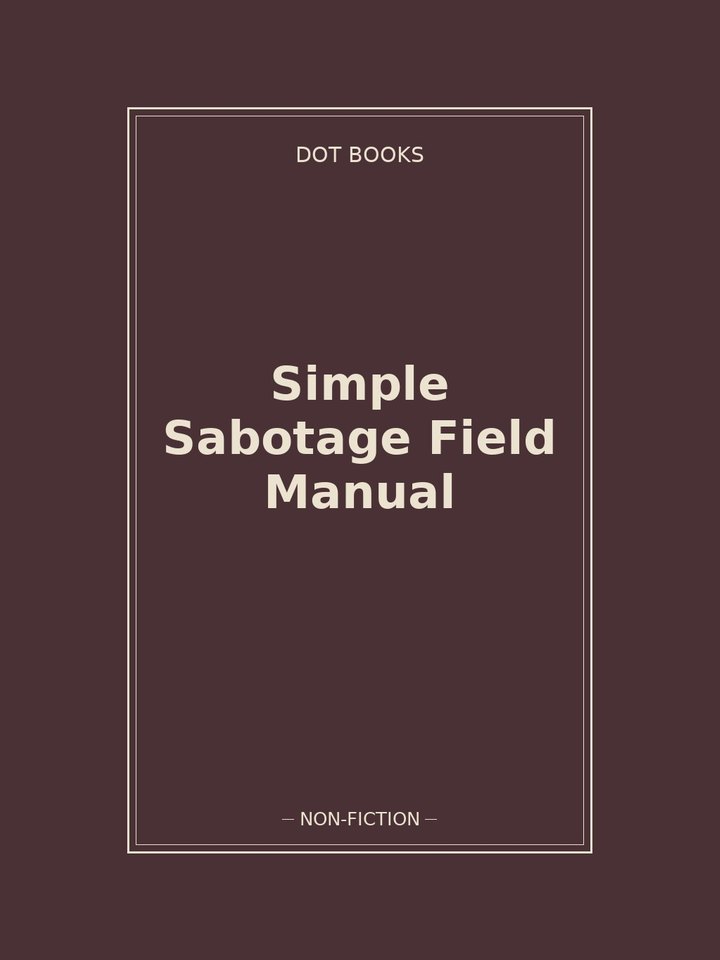
Simple Sabotage Field Manual.
The declassified wartime guide produced by the American OSS, teaching ordinary citizens in occupied Europe how to obstruct the enemy through everyday slowness and mistakes. Startlingly relevant today as a study of how organisations quietly break.
Recommended for you.

Options and costs for your address appear at checkout
Send it back if it didn't land
Every book on the shelf has been read by at least one of us
About this book
Some of the most effective sabotage requires no explosives at all, only the willingness to be a little slow, a little literal, a little unhelpful. This slim wartime manual, produced by the American Office of Strategic Services and later declassified, set out to teach exactly that.
What it's about
Issued during the Second World War, the manual was designed to instruct ordinary people in occupied and enemy territory in acts of quiet obstruction, the kind that could be carried out with everyday tools and plausible deniability. It offers practical advice on interfering with machinery, transport and production, but its most enduring pages concern the sabotage of organisations themselves: how to hold up decisions, multiply meetings, insist on proper channels, and grind efficient work to a halt while appearing entirely cooperative. The tone is dry, procedural and matter-of-fact throughout.
Themes
Beneath its wartime purpose, the manual is really about how institutions function and fail. It reveals, with unnerving clarity, how much productive work depends on goodwill, and how easily that work can be undone by rule-following taken to an extreme. It is a document about power without violence, about the small frictions that can defeat a system from within, and about the strange closeness between deliberate obstruction and ordinary bureaucratic behaviour.
Why it still matters
Rediscovered by later readers, the manual has taken on a second life as an unintentional commentary on modern working life. Its list of techniques for slowing an organisation reads, uncomfortably, like a description of many a real workplace, which is precisely what makes it so often quoted. As history it is a fascinating artefact of wartime resistance; as a mirror, it is sharper still.
Who it's for
For readers of history and wartime intelligence, for anyone interested in organisations and how they work, and for those who appreciate a document that is both genuinely useful and quietly, darkly funny. A short read with a long afterlife.
Story preview
Tap to flip through the photos and the key points.
 Simple Sabotage Field Manual
You might also like
Readers who picked this also reached for.



Picking up where you left off