"Fantastic"
Books
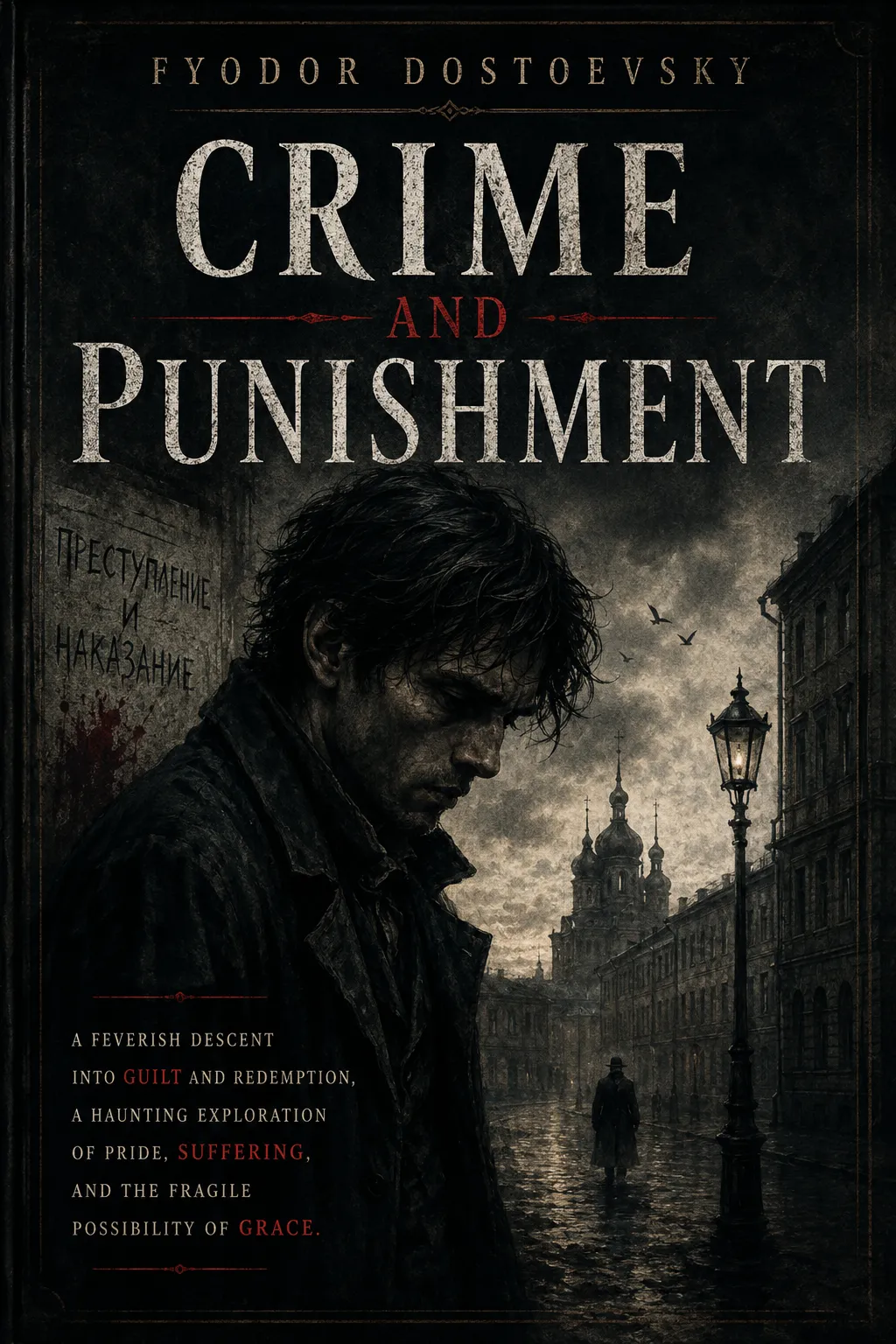
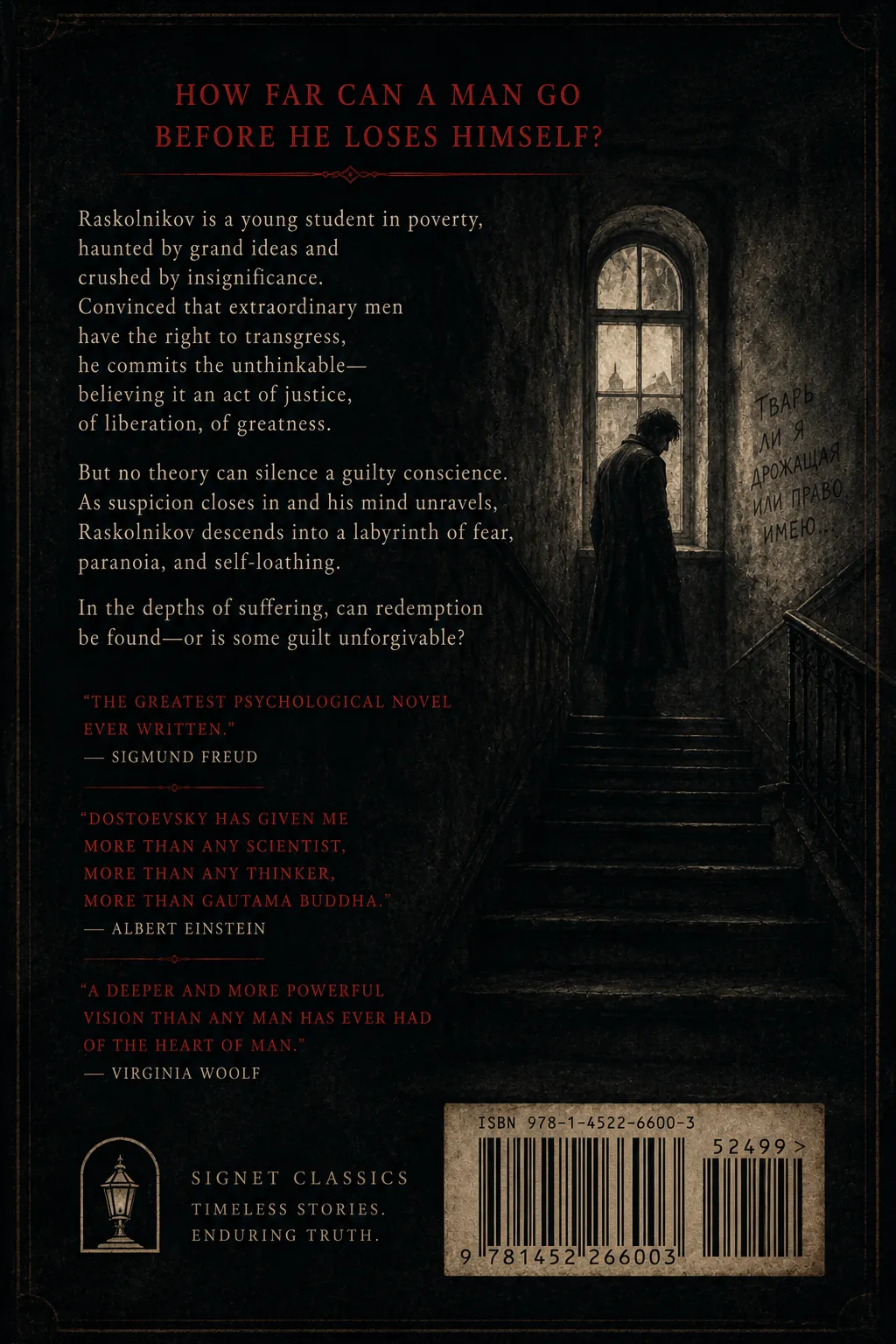
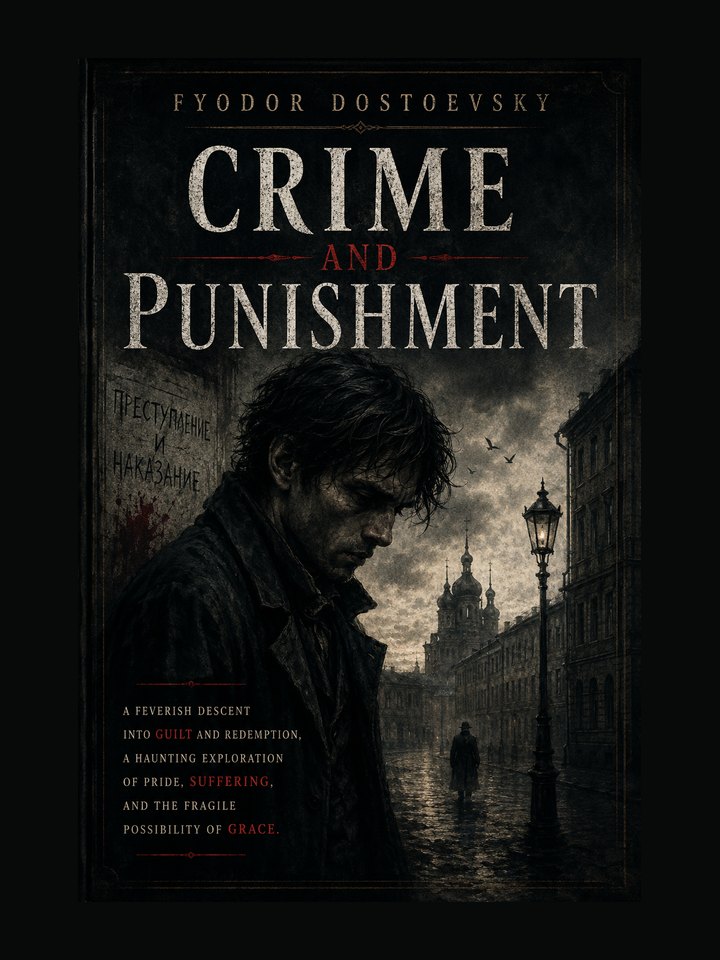
Crime and Punishment.
A feverish descent into guilt and redemption, Dostoevsky’s 'Crime and Punishment' follows a tormented student who believes he’s beyond morality—until his crime consumes him. A haunting exploration of pride, suffering, and the fragile possibility of grace.
From $5.00
Choose an edition
Recommended for you.
Delivery shown before you pay
Options and costs for your address appear at checkout
30-day returns
Send it back if it didn't land
Always read first
Every book on the shelf has been read by at least one of us
Edition details
- Fyodor Dostoyevsky
- DotBooks
- Paperback
- Standard white
- 727
- en
Featured in
About this book
In the stifling heat of St. Petersburg, a young man’s mind unravels as he grapples with a crime he believed would prove his superiority. Dostoevsky’s 'Crime and Punishment' is a psychological labyrinth, where guilt gnaws at the soul and redemption flickers like a distant flame.
What it's about
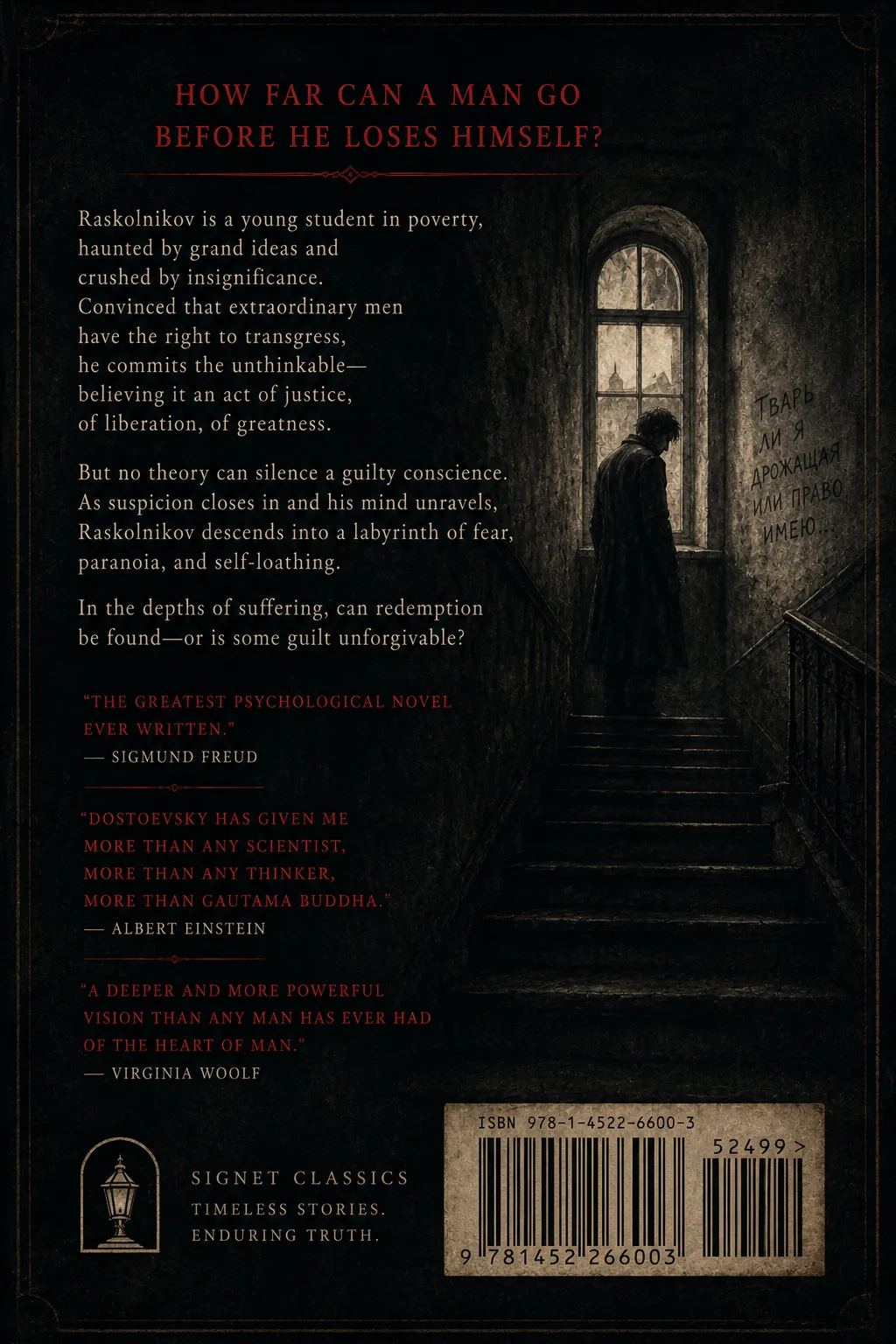
Raskolnikov, a destitute former student, commits a brutal murder, convinced that his extraordinary intellect places him above conventional morality. But the act fractures his psyche, plunging him into a spiral of paranoia and guilt. As he navigates the oppressive streets of St. Petersburg, he encounters a cast of vividly drawn characters—each grappling with their own struggles. Among them is Sonia, a selfless young woman whose compassion becomes a beacon of hope. The novel traces Raskolnikov’s tortured journey toward confession and the possibility of redemption, set against a backdrop of poverty, despair, and moral reckoning.
Themes
At its core, 'Crime and Punishment' interrogates the boundaries of morality and the consequences of pride. Raskolnikov’s belief in his own exceptionalism leads him to justify murder, but Dostoevsky exposes the fallacy of such reasoning through his protagonist’s psychological unraveling. The novel also delves into themes of suffering and redemption, particularly through the character of Sonia, whose quiet strength embodies the transformative power of love and forgiveness. Dostoevsky’s exploration of guilt and conscience remains profoundly unsettling, forcing readers to confront uncomfortable questions about human nature.
Why it still matters
Dostoevsky’s novel resonates deeply in contemporary discussions of morality, justice, and the human condition. Its psychological depth and moral complexity make it a timeless exploration of the consequences of arrogance and the redemptive potential of humility. In an era marked by moral relativism and ideological divides, 'Crime and Punishment' serves as a stark reminder of the universality of guilt and the necessity of empathy. Its influence extends beyond literature, shaping philosophical and psychological discourse on free will, responsibility, and the nature of evil.
Who it's for
Readers drawn to psychological intensity and moral complexity will find 'Crime and Punishment' deeply compelling. It appeals to those who appreciate dense, character-driven narratives and philosophical inquiries into human nature. Fans of works like Camus’ 'The Stranger' or Kafka’s 'The Trial' will recognize the existential undertones, while admirers of Tolstoy or Chekhov will appreciate Dostoevsky’s vivid portrayal of Russian society. This novel is for those unafraid to confront the darker corners of the human psyche.
On reading it now
In 2026, 'Crime and Punishment' feels remarkably prescient, its exploration of moral ambiguity and societal alienation echoing contemporary concerns. As readers navigate a world increasingly defined by ideological divides and ethical uncertainty, Dostoevsky’s masterpiece offers a profound meditation on the consequences of hubris and the enduring possibility of redemption. Its psychological depth and moral urgency continue to resonate, reminding us of the timeless relevance of grappling with our own humanity.
Related reading
If this resonates, you might also reach for Anna Karenina, Madame Bovary, or Self-Reliance and Other Essays.
Sources and references
Verified references for this edition: Open Library, WorldCat.
Story preview
Tap to flip through the photos and the key points.
 Crime and Punishment
Reader letters
What others said.
You might also like
Readers who picked this also reached for.
Picking up where you left off
Recently viewed.
From
$5.00