Books
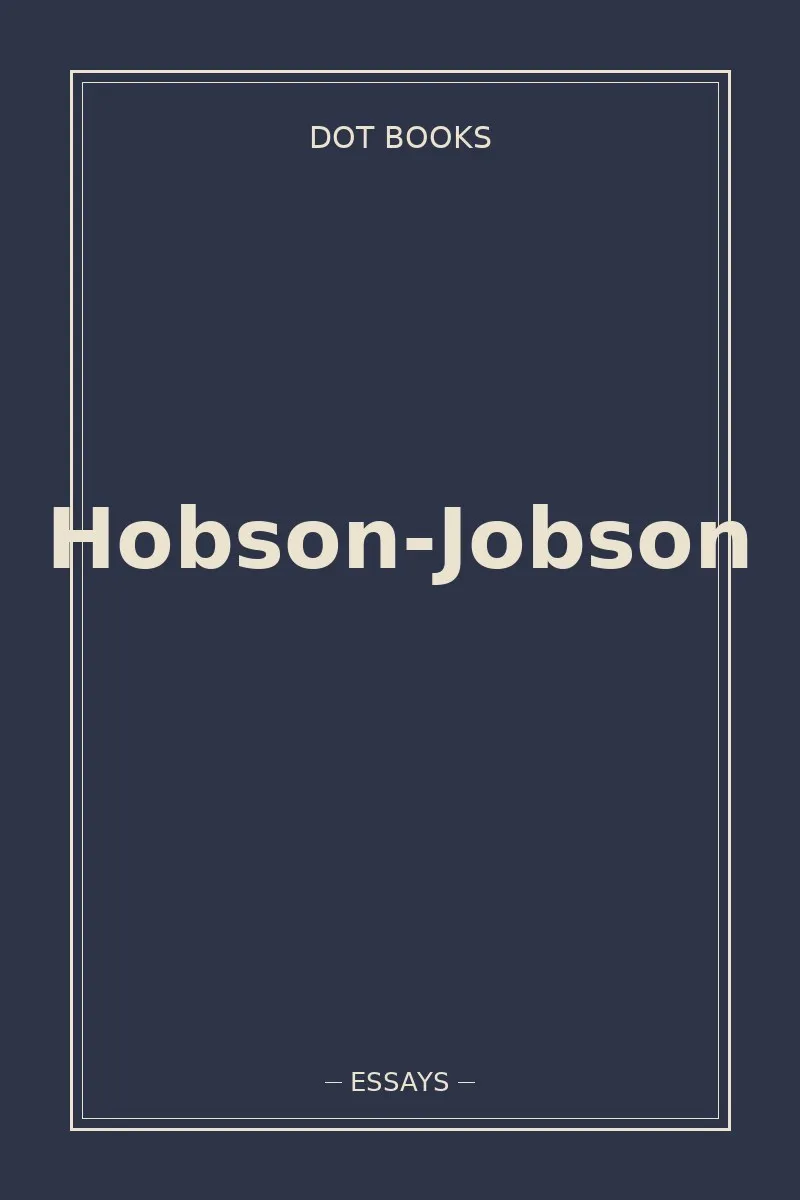
Hobson-Jobson.
The famous Anglo-Indian glossary that traces how words like bungalow, shampoo, curry and pyjama passed from India into English, part dictionary, part treasure-house of colonial encounter.
Recommended for you.


Options and costs for your address appear at checkout
Send it back if it didn't land
Every book on the shelf has been read by at least one of us
About this book
Few reference books are as pleasurable to browse as this celebrated glossary, which set out to explain the strange, hybrid vocabulary that British life in India had produced.
What it's about
Compiled by Henry Yule and A. C. Burnell and first published in 1886, Hobson-Jobson is a dictionary of Anglo-Indian words and phrases, the terms that soldiers, administrators, traders and travellers absorbed from Hindi, Persian, Arabic, Tamil, Portuguese and beyond. Each entry does far more than define. It follows a word back through centuries of quotations, tracing how bungalow, juggernaut, shampoo, curry, loot and hundreds of others travelled, mutated and settled into English. The title itself is a specimen, an English mangling of an Arabic religious cry.
Themes
The book is a monument to linguistic borrowing and to the long, tangled meeting of Britain and South Asia. It shows language as a record of contact, commerce and conquest, and it carries all the assumptions of its imperial moment even as it preserves an extraordinary amount of scholarship and stray delight.
Why it still matters
Linguists, historians and lexicographers still cite it, and general readers still fall into it for hours. It is a primary source on how empire reshaped the English language, and a reminder of how much of everyday speech carries the sediment of distant places.
Who it's for
For word-lovers, etymology hunters, students of colonial history, and anyone who enjoys a reference book that reads like an adventure.
Story preview
Tap to flip through the photos and the key points.
 Hobson-Jobson
You might also like
Readers who picked this also reached for.

Picking up where you left off