Books
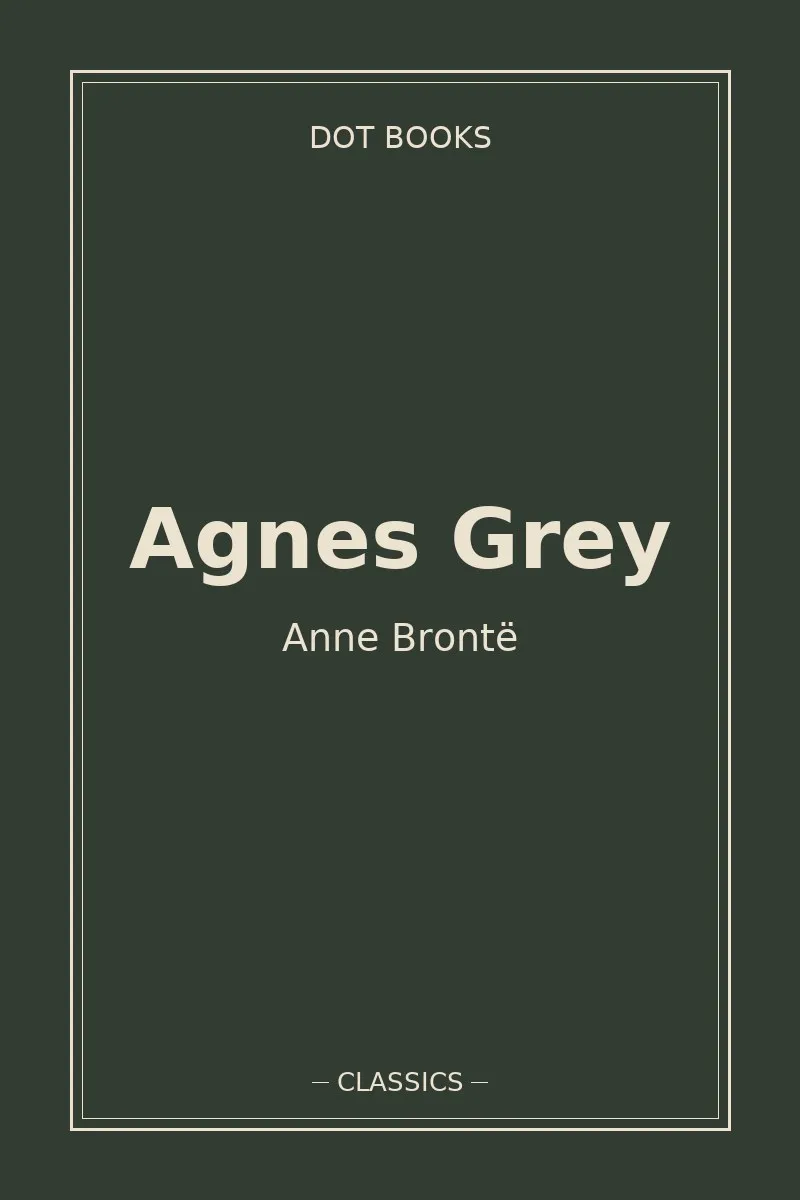
Agnes Grey.
Anne Brontë's clear-eyed first novel follows a clergyman's daughter into the thankless world of the Victorian governess, where gentility masks cruelty and quiet integrity is its own reward.
Choose an edition
Recommended for you.



Options and costs for your address appear at checkout
Send it back if it didn't land
Every book on the shelf has been read by at least one of us
Edition details
- Anne Brontë
- DotBooks
- DotBooks
- Paperback
- Standard white
- 219
- en
About this book
A young woman steps out of a loving but impoverished parsonage, certain that earning her own keep will be an adventure. What she finds instead is a household that treats her as furniture with feelings.
What it's about
Agnes Grey traces the working life of a clergyman's daughter who takes posts as a governess to help her family. Passed between families of the newly rich and the carelessly genteel, she is charged with children who have never been told no and employers who see her neither as servant nor equal. Drawing directly on Anne Brontë's own years in service, the novel records the daily indignities of the role with an unflinching, almost documentary honesty, while a tentative attachment to a country curate offers Agnes a horizon beyond the schoolroom.
Themes
The book is quietly furious about class and the peculiar limbo of the governess, respectable yet powerless, present yet invisible. It weighs the moral education of children against their material spoiling, and sets Agnes's plain Christian steadiness against the vanity and cruelty around her. Kindness to animals and to the poor becomes, in Brontë's hands, a reliable measure of character.
Why it still matters
Where her sisters reached for storm and passion, Anne Brontë wrote with restraint, and that restraint has aged remarkably well. Agnes Grey reads now as one of the earliest realistic accounts of women's paid work, honest about tedium, loneliness and the small humiliations of dependence. Its refusal to romanticise makes it feel startlingly modern.
Who it's for
For readers who love the Brontës and want the sister often left in shadow, for anyone drawn to Austen or Gaskell's social observation, and for those who prefer their nineteenth-century fiction wry, moral and true to life rather than gothic.
Sources and references
Verified references for this edition: Open Library, WorldCat, Anne Brontë on Wikipedia.
Story preview
Tap to flip through the photos and the key points.
 Agnes Grey
You might also like
Readers who picked this also reached for.

Picking up where you left off